2026年11月3日
English
Japanese
Minato Unesco Association

What Can Be Done for Peace through UNESCO’s “Memory of the World” Initiative
2025 Minato UNESCO Association SymposiumWhat Can Be Done for Peace through UNESCO’s “Memory of the World” Initiative
Date: Wednesday, Feb. 4, 2026
Venue: International House of Japan
Organizer: Minato UNESCO Association
Co-organizer: Minato City Board of Education
Speakers:
KOBAYASHI Miho, Deputy Director-General, Japanese National Commission for UNESCO
SHIBATA Taizan, Researcher, Jodo-shu Research Institute
Panelists: Tokyo Metropolitan Mita High School UNESCO Committee GOTO Yuua (2nd grader), MARUYAMA Taisei (1st grader), FUKAI Sayaka (2nd grader), TAKAHASHI Kaho (1st grader)
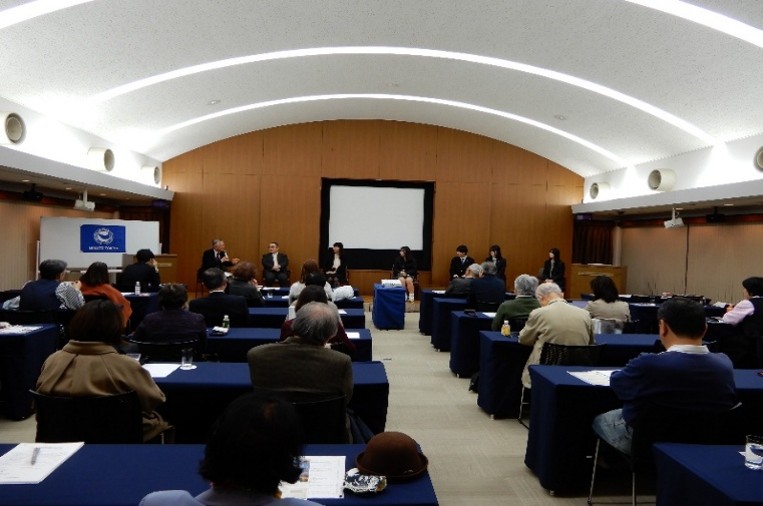
The symposium was held on the theme of the significance and role of UNESCO’s “Memory of the World” Program, following the 2025 inscription of the Tripiṭaka preserved at Zōjōji Temple—head temple of the Jōdo-shū located in Minato City. After a video message from Minato City Mayor Ai Seike, Ms. Miho Kobayashi of the Japanese National Commission for UNESCO introduced the “75th Anniversary Project of Japan’s Accession to UNESCO” and delivered a lecture. This was followed by a lecture by Mr. Taizan Shibata of the Jōdo-shū Comprehensive Institute, and proposals from students of Tokyo Metropolitan Mita High School. A summary follows.
Ms. KOBAYASHI Miho
“About UNESCO’s ‘Memory of the World’ Initiative”
The initiative began in 1992 (the inscription system started in 1995). Its objectives are:
- To protect and preserve documentary heritage of global significance.
- To make such heritage accessible to as many people as possible.
- To raise awareness of the existence and importance of documentary heritage in member states.
Public recognition in Japan is still developing, but the recent inscription of Zōjōji’s scriptures has drawn attention, and we hope to build on this momentum. Below is an outline of the inscription system.
Application Process: Organizations that hold the materials submit an application to the Japanese National Commission for UNESCO, where it is reviewed. The cycle occurs every two years. The Commission selects up to two candidates and recommends them to UNESCO. The final decision is made by a committee at UNESCO Headquarters.Inscription System: Inscription is not the goal but the starting point. Once materials are internationally recognized, full-scale efforts to preserve, utilize, and disseminate them begin. Inscription marks the beginning of actions to ensure that the materials serve the future.
Eligible Materials: Handwritten manuscripts, books, newspapers, posters, maps, films, photographs, digital records, etc. Examples include the Gutenberg Bible, Chinese oracle bone script, and Beethoven’s handwritten score of the Ninth Symphony.
Current Numbers:
- International inscriptions: 570
- Regional inscriptions: 86 Japan:
- International inscriptions: 9
- Regional inscriptions: 1
Under Review (2026–2027 International Cycle): Fūshi Kaden, Zeami’s treatise on Noh, transmitted by the Kanze family. The decision will be announced in spring 2027.
Future Outlook: A major challenge is the small number of applications. We aim to identify suitable cases that align with the purpose of “Memory of the World,” organize them into a list, and develop a system within the Ministry of Education, Culture, Sports, Science and Technology to support applicants. Through such efforts, preserving records will help transmit the past, and making them public will deepen intercultural understanding. International dissemination will foster cross-border dialogue and mutual respect, nurturing an attitude that embraces diversity.
Although political tensions have arisen in the past—such as those related to “historical recognition”—the programme is not meant to create conflict. Its fundamental philosophy is to safeguard humanity’s shared documentary heritage, deepen mutual understanding, and build the defenses of peace. We believe that continued efforts will ensure that “Memory of the World” contributes steadily to UNESCO’s mission of building peace.
Mr. SHIBATA Taizan
“What Can We Do Now, Starting from the ‘Memory of the World’ Inscription of Zōjōji’s Tripiṭaka?”
Religious Scriptures
Twelve thousand woodblock-printed volumes of the Tripiṭaka have been inscribed in UNESCO’s “Memory of the World.” This was made possible thanks to the Ministry of Education and the UNESCO Association. These scriptures were donated by Tokugawa Ieyasu. Sutras originally composed in India were translated in China and written entirely in Chinese characters.
If we consider the Tripiṭaka not merely as Buddhist texts but as “religious scriptures,” then Christianity, Islam, and other religions also possess significant documents. There may be no other example of religious scriptures being inscribed in “Memory of the World.” Religious scriptures are believed to contain ultimate truth or divine words, serving not as mere reading material but as guides to life and explanations of the world’s origins. They are where believers encounter the divine and hear sacred words. In this sense, one hears God’s words in the Gutenberg Bible or the Qur’an, and one hears the Buddha’s voice in the Tripiṭaka. The significance of the inscription lies in the recognition of religious scriptures as global cultural heritage.
The Tripiṭaka and Zōjōji’s Three Editions The Tripiṭaka consists of the Buddha’s teachings (Sūtra), monastic regulations (Vinaya), and commentaries (Śāstra), collectively called the “Three Baskets.” Translators were known as “Tripiṭaka Masters.” Buddhism, a world religion, has scriptures translated into Sanskrit, Pali,
Tibetan, and Chinese; Zōjōji preserves the Chinese versions. The three editions are:
- Song edition
- Yuan edition
- Goryeo edition Together known as Zōjōji’s “Three Tripiṭakas.”
They represent the culmination of printing culture, Chinese-character culture, and movable-type culture. Zōjōji, as the Tokugawa family temple, preserves the history of the shogunate and the Jōdo-shū tradition.
Peace as Seen Through Zōjōji’s Tripiṭaka
- Recognizing the existence of others requires diversity, plurality, cooperation, and tolerance. Different cultures and faiths must respect and coexist with one another.
- The Tripiṭaka teaches ways to overcome suffering and advocates prayers for peace and tranquility.
- “Prayers for peace” reflect humanity’s desire for peace and its ability to create peace. This aligns with UNESCO’s founding spirit. These constitute the significance of the Tripiṭaka’s existence.
Tokyo Metropolitan Mita High School UNESCO Committee
“Expectations from the Younger Generation”
GOTO Yuua (2nd grader)
I am truly grateful for the opportunity to speak here today as one of the younger participants. I will introduce our committee and share the current level of awareness among young people regarding “Memory of the World,” followed by our proposals and expectations for the programme. First, our committee chair will introduce our activities.
MARUYAMA Taisei (1st grader)
I am Maruyama, the committee chair. The Mita High School UNESCO Committee works daily to engage students and parents. We operate in four teams; today I will introduce two that were active during our school festival. At the September festival, we held a bazaar and a fundraising campaign. Before fundraising, we invited the international NGO “Earth Stage,” which provides support in Gaza, to speak about the current situation there. This deepened our understanding and strengthened the meaning behind our activities. We raised 60,000 yen through the bazaar and donations, and with additional student council proceeds, donated a total of 160,000 yen to Earth Stage. This became an opportunity for students to reflect on wars and conflicts around the world. We hope to continue expanding our activities and contributing to society.
GOTO Yuua (2nd grader) Our school is located near Zōjōji. Learning that the Tripiṭaka had been carefully preserved over centuries and recognized by “Memory of the World” made me realize that preserving and transmitting records is not only the responsibility of people in the past. The inscription represents accumulated knowledge handed down through generations and a message to each of us for the future. Yet, as I myself did not know about it, the reality is that “Memory of the World,” despite its value, remains largely unknown among younger generations.
To assess awareness, we conducted a survey at school (101 students, 1st and 2nd year):
- Do you know UNESCO’s “Memory of the World”? Yes: 2.8% / No: 97.2%
- Do you know Zōjōji’s Tripiṭaka? Yes: 2.8% / No: 97.2%
- Would you like to learn more about the programme? Yes / Somewhat: 85%
- What would be suitable candidates? “Hiroshima photographs,” “The Tale of Genji,” “Ukiyo-e,” “Photographs of the 2011 Great East Japan Earthquake”
- Effective ways to promote awareness? Examples: SNS, exhibitions, films, collaboration with companies
The survey showed strong interest among students—they want to learn, deepen understanding, and share. The issue is not lack of interest but lack of opportunities. Therefore, we believe it is essential to create mechanisms that allow students to engage personally, not merely receive information.
FUKAI Sayaka (2nd grader)
Next, we propose experiential activities to make “Memory of the World” more accessible. Workshops can serve as important entry points. The Tripiṭaka has value not only as preserved material but through understanding its words and background, and considering how we interpret it today.
TAKAHASHI Kaho (1st grader)
We also propose collaboration with local communities and national institutions. Specifically, establishing special information booths at events held at Zōjōji. The temple hosts many events throughout the year, attracting visitors from Japan and abroad. Providing an information hub in such settings would allow people unfamiliar with “Memory of the World” to encounter it naturally. This would help reposition the programme from specialized knowledge to familiar cultural resources.
Summary: Proposals and Expectations from High School Students
1. Workshops
- Experiential workshops using the Tripiṭaka
- Translation and interpretation activities: not professional translation, but rephrasing into modern language and considering how the words connect to today’s society.
- Four thematic workshops:
- Choosing: Compare historical materials and consider what one would select as “Memory of the World.”
- Time: Record present-day experiences and imagine how people 100 years later would perceive them.
- Things we cannot afford to lose: Imagine a world without recorded culture or values and recognize that records are not guaranteed.
- Presentation of records: Create exhibition plans or explanatory texts from a student’s perspective.
2. Collaboration with Local and National Institutions
- Establish special booths at Zōjōji’s 30+ annual events.
- Use public facilities (libraries, community centers) for exhibitions and experiential learning.
Review the national selection process: currently the Ministry selects candidates, but in the future, citizens could propose candidates and experts could evaluate them.
3. Expectations: Creating Opportunities to Learn
- Workshops and selection methods for “Memory of the World.”
- Activities within Mita High School to ensure learning does not end with awareness.
- Expanding the meaning of records:
- Records are not only preserved for future generations;
- Choosing, preserving, and recording are actions we ourselves must engage in.
- Meaning grows when we think and act for ourselves.
4. Final Expectation If various initiatives encourage more people to take interest in “Memory of the World,” the significance of the initiatives’ registration system will grow even further.
We are very grateful for the two speakers, Ms. Kobayashi and Mr. Shibata, as well as for the Mita High School UNESCO Committee students who jointed as panelists.
(Written by SATO Ritsuko, the International Science & Culture Committee, and translated by TANAHASHI S., the PR & Internet Committee)