2026年1月31日
English
Japanese
Minato Unesco Association

Can the UNESCO spirit overcome international conflicts?
The First Cross-cultural Lecture for FY2025
Can the UNESCO spirit overcome international conflicts?
Date: July 12, 2025
Venue: Minato City Gender Equality enter Libra
Lecturer: Professor KOBAYASHI Akira, the faculty of education, Tamagawa University Workshop Facilitators: EHARA Tomoka and SAITO Kaede, Members of the UENSCO Club “Le Lien” of Aoyama Gakuin University
Professor Kobayashi has been a long-time mentor of Tamagawa University’s UNESCO Club. He has organized and conducted study tours for the club member students to visit the UNESCO headquarters in Paris. He generously agreed to give a comprehensive presentation on UNESCO for MUA.
In Part I, Professor Kobayashi gave an illuminating audio-visual presentation about UNESCO. In Part II, the audience joined workshops, facilitated by Ms. Ehara and Ms. Saito.
Summary of Part I.
- UNESCO promotes transformative education toward peace.
■UNESCO’s emphasis in education has changed from value education to transformative education. This means more emphasis is placed now on peaceful and sustainable values, in terms of the way of perception, livelihood and thinking.
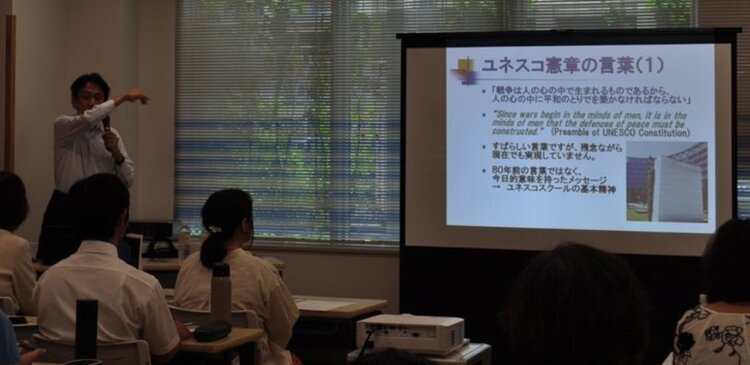
■The world is currently challenged by conflicts and division
We are today challenged by a possibility of World War III. Education and UNESCO activities should address the scary future, by nurturing the awareness of global citizenship and by strengthening the skill to solve various conflicts.
■The world today is characterized by contradiction
The world is facing accelerating international conflicts and the emergence of exclusive nationalism. On the other hand, globalization and international solidarity are concurrently under way.
- The progress in ICT and AI technology has enabled the instantaneous sharing of information throughout the world, thereby enhancing the connectivity among people.
・An increasing number of issues have emerged, which should be addressed by the whole world as one solid community. They include climate change, maritime pollution, energy problems, food shortage and water supply, among others.
■Phrase from the UNESCO Constituion (1)
On the face of a stone epitaph, erected in the inner yard of the UNESCO headquarters in Paris, we can see the famous phrase taken from the preamble of the UNESCO Costitution – “Since wars begin in the minds of men, it is in the minds of men that the defense of peace must be constructed.” It is expressed in six official languages, including English, French, Russian, Spanish, Chinese and Arabic.
■Phrases from the UNESCO Constitution (2)
The UNESCO activities are based on the following credo:
“The ignorance of each other’s ways and lives has been a common cause, throughout the history of mankind, of that suspicion and mistrust between the peoples of the world through which their differences have all too often broken into war.”
Therefore, the importance should be placed on the cross-cultural study and education to foster global citizenship awareness, in order to build peace..
■Mainstay UNESCO activities
・Education, science (natural science & liberal arts), culture and communication
・Formulation of a vision which addresses the solution of contemporary issues facing the mankind.
■Transformative education proposed by UNESCO
Throuughout the 80 post-war years, UNESCO has proposed a variety of transformative education models, ranging from value education to transformative pedagogy, as guidelines which would help to improve or solve critical issues during the different periods of contemporary mankind.
■The 2023 New UNESCO Education Advisory (Revised version of the 1979 UNESCO Education Advisory)
・This advisory was adopted at the 42nd UNESCO General Assembly on November 20, 2023.
・This new advisory organizes and connects various issue areas, such as ESD (Education for Sustainable Development), GCED (Education for Global Citizenship), digital technology and AI, climate change, gender issues, and fundamental human rights.
・The Japan Association for International Education developed a card-type learning tool and has utilized various networks.
■The 2023 UNESCO Education Advisory
It is charactered by the importance placed on the role of UNESCO networks.
・The member countries which ratified the Article 71 are making efforts in expanding domestic activities, related to the advisory, promote the interconnection between the ESD and GCED, under the support from the UNESCO-related programs and networks, such as the UNESCO chair, the UNITWIN network (an organization which pursues collaborative issue solution joined by universities in both developed and developing countries) and the UNESCO Schools (ASPnet).
ESD and SDGs
■ESD (Education for Sustainable Development)
– The main initiative is “transformation of values and behavior in order to realize a sustainable society.” Based on the awareness that the status quo is not sustainable, the ESD addresses the said initiative so that mankind can survive in the coming 100 to 1,000 years. The Ministry of Education, Sports, Science and Technology is designating UNESCO Schools as the platform to promote ESD.
・The “ESD for 2030” vision was adopted at the 2015 UN General Assembly. It addresses the support for young generations as well as the enhancement of educators’ skilll and the transformation of learning environment.
■SDGs
This initiative, adopted at the 2015 U.N. General Assembly, addresses a total of 17 important goals which are expected to be attained by 2030. However, the track record suggests infeasibility to attain the goals by 2023. It seems likely that, in 2030, the U.N. will adopt a follow-on initiative for these goals, which will become a guideline for UNESCO activities.
■ESD and SDGs are the key to foster global human resources
To be a global person, the awareness about international issues is more important than English proficiency. Such person would be required to have committed intention to improv e and solve various world issues by proposing creative ideas.
■Co-existing society rather than competitive society
・During the advancement of globalization, new programs and concepts have been developed such as the 21st century-type skills, International Bacalaureate, and global competency, to foster global human resources,
・However, it is desirable that the fostering of “co-existing”-minded global human resources be promoted, to offset the negative aspect of the competition. This effort is what UNESCO proposes as transformative education. The U.N. and UNESCO pursue a co-existing society, not a competitive one, where no one will be left behind.
- Collision of different values
■Complication of values
・In the modern society, diversity is a respected value. However, different values or moral judgements arise depending on nationality, ethnicity, religion, political opinions, profession, generation or gender. We have seen an increasing number of cases where difference in values ends up in collisions or complication. Coexistence is not an easy issue to realize.
・In modern society, it is increasingly difficult to judge what is right and what is wrong.
・We moderners are required to acquire the skill to consider and solve the complication in values we face.
■Clash of civilization
Huntington predicted in his book “Clash of Civilization” that, in the 21st century, it would be not ideology but difference in various civilization, consisting of different ethnicity, religion, etc., that would cause escalating clashes and disrupt the human society. Today, we are facing the following conflicts and awakened about the validity of his insightfulness:
・The U. S. vs China rivalry
・Confrontations between the U. S. and Islamic states
・Confrontation between Russia and the NATO countries
■Women’s status in the Islamic religion
・The status of women in the Islamic society is based on the teaching in the Koran and its annotated edition “Hadith.” The perception of women in the Islamic religion reflects substantially the traditional paternalism in the Islamic tribal society. Simply put, women are beings to be protected. In Chapter 4 “women” in the Koran, there is a teaching that seems to suggest that Allah did not place male and female on an equal status.
・Those, who believe in Taliban or Islamic fundamentalism, think that they have no obligation to listen to opinions from outside because they are faithfully observing the teaching of the Koran, which are identical with the words of God. From their viewpoint, criticism expressed by Europe and the U. S. is totally inappropriate. This is a typical example of the clash of civilization.
・It seems debatable how much teachings of the Koran should be applied to the modern society.
■Question to the audience
・Don’t you think that there is no fundamental solution to the clash of civilization? I personally feel that, in order to build the concept of a genuine ”universal citizenship,” we should choose a UNESCO-based, forward-looking approach and endow a citizenship status to the non-Western civilizations, such as the Islamic, Chinese, Hindu and others. Such civilizations have been nurtured in the cultural traditions that had been handed down over thousands of years. Instead of defining these civilizations as pre-modern, we should integrate whatever universal elements present in the civilizations, and create a new citizenship model. What do you think?
- What is GCED (Global Citizenship Education)?
■What is a global citizen?
・It is one of the education programs on which UNESCO has placed top priority. It has a conceptual image, similar to the phrase “Alle Menschen werden Brieder” in Beethoven’s No.9 symphony
■ESD and GCED
These are UNESCO’s top-priority education programs.
■Global Education First Initiative
It was proposed in 2012 by the U. N. Secretary General Ban Ki-moon.
- Three major objectives were included; (1) School education for all, (2) Improvement in the quality of learning, and (3) Nurturing of global citizen awareness. Based on this initiative, UNESCO launched GCED in 2013.
■Objective of GCED
・To provide such education as will foster human resources who, facing global issues challenging the whole mankind, are able to (1) consider ways to solve the issues from both local and global viewpoints, and (2) make active contributions to solving the global issues.
- Viewpoints which can overcome the clash of judgements
■Today, we are seeing the “Clash of Civilizations” in the world. Each party insists that what they are doing meets morality but that the other party is responding in an ethically wrong attitude. This antagonistic relation applies to the Russia vs Ukraine war, as well as the Israel vs. Palestine conflict, the U. S. vs China rivalry, and the U. S. vs Iran conflict. We must work out viable viewpoints and means which will enable both parties to overcome the clash of justices.
■Questions to the audience
・The World Human Rights Declaration was adopted at the third U. N. General Assembly on December 10, 1948 (with 48 favor votes, 8 abstentions, and no opposition). Hence, the world observes the World Human Rights Day on December 10th. The eight countries which abstained included the U.S.S.R., Ukraine, Belarus, Yugoslavia, Poland, South Africa, Czech, Slovakia, and Saudi Arabia. This means that these eight countries did not regard the concept in the World Human Rights declaration, proposed by the U. N., as universal values. Now, I’d like to ask the audience the following question:
・We are expected to respect cultural diversity but not sure about how much diversity we should accept. Can there be an acceptable level of diversity in our perception of democracy, human rights, peace or war? For example, the official state name of North Korea is the Democratic People’s Republic of Korea. The country’s website states that it is governed as a people-centric state, based on democracy as the national principle. Is their perception of democracy wrong?
■Factors which obstruct co-existence
・Hatred and distrust
・Example of negated co-existence: UNESCO Crisis Heritage
・Implication of the destruction of the Bamiyan Valley Buddhist remains
- UNESCO Schools and Civic UNESCO Movements
■UNESCO school initiative was started in 1953 as a worldwide network of schools (ASPnet).
No. of UNESCO schools in Japan: 1,083 (as of September 2025)
No. of UNESCO schools worldwide: 12,000 in 182 countries (as of March 2025)
・UNESCO schools in Minato City
Sacred Heart School Tokyo: Primary, Middle and High Schools
Tokyo Metropolitan Mita High School
・Study themes which UNESCO encourages UNESCO Schools to pursue:
- ESD (Education for Sustainable Development)
- GCED (Global Citizenship Education & Culture of Peace and Non-violence)
- International Learning
・UNESCO member states which are waging wars or autocratic:
Russia, Ukraine, Palestinian National Authority, North Korea, Afghanistan, Myanmar, Sudan, etc.
・UNESCO schools in Russia: 280
・UNESCO schools in Ukraine: 79
Is it not possible to work out a path to peace in the aforementioned countries, by networking their local UNESCO associations and UNESCO schools? Possibility for peace may arise from where politics does not prevail.
・Worldwide network of civic UNESCO movements:
Japan: 268 UNESCO Associations (as of June 2025)
Worldwide: 4,921 UNESCO Associations (89 countries)
Part II Workshop The workshop was organized by the afore-mentioned UNESCO Club member students of Aoyama Gakuin University – Tomoka Ehara and Kaede Saito. The objective was to discuss the multi-cultural understanding from the viewpoint of UNESCO spirit.
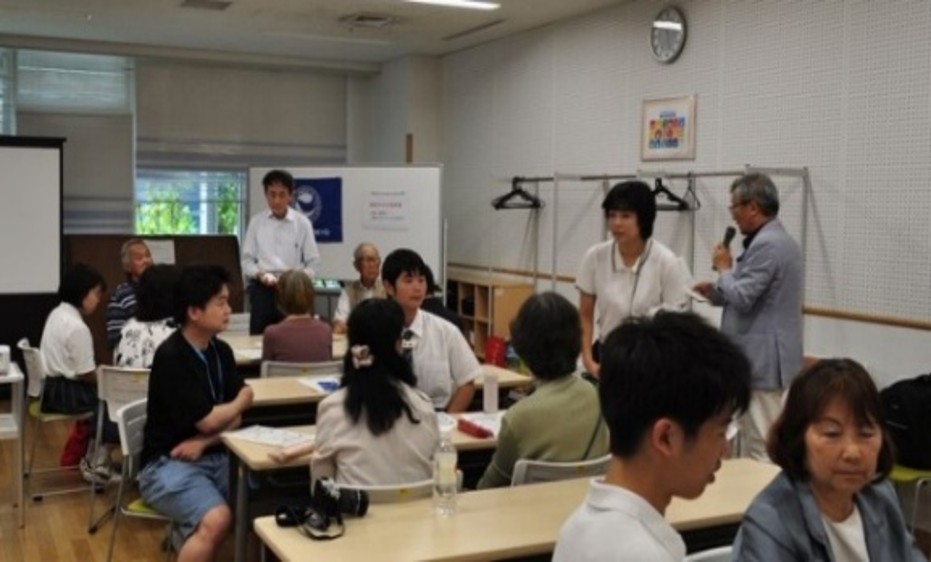
The attendees were divided into four groups and requested to discuss one of the four topics – cooking, sports, clothes or music. They were expected to represent different countries and express opinions which would highlight superiority over other countries. Such discussions made the attendees feel the nature of the multi-cultural co-existence. The UNESCO committee member students of the Mita metropolitan High School played the role of facilitator in each of the groups.
We’d like to extend hearty thanks to Professor Kobayashi, workshop organizers, facilitators and all attendees.
We felt that the lecture and workshop were very meaningful, especially because the world is seeing the continuation of multiple wars today.
(Written by SATO Ritsuko, the International Science & Culture Committee, and translated by TANAHASHI S., the PR & Internet Committee)