2026年1月31日
English
Japanese
Minato Unesco Association

“Every Japanese Person Should Know: The Culture of Delicious Fish”
“Every Japanese Person Should Know: The Culture of Delicious Fish”
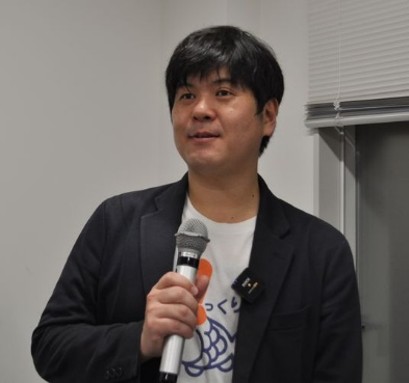
Speaker: Issei Nagasaki, Fish Coordinator/Lecturer,Tokyo University of Marine Science and Technology
Date: Saturday, November 29, 2025
Venue: Minato Ward Gender Equality Center, Libra Learning Room C
1.Self-Introduction
Born and raised in a fisherman’s family in Tsutsuishi, Itoigawa City, Niigata Prefecture → Tokyo University of Marine Science and Technology → Worked at Tsukiji Market → Completed doctoral course at Tokyo University of Marine Science and Technology → Worked at a major telecommunications company & established a fish association → Became an independent expert on delicious fish
Currently, seminar lecturer, writer, event organizer, PR, ICT support, and fish advisor
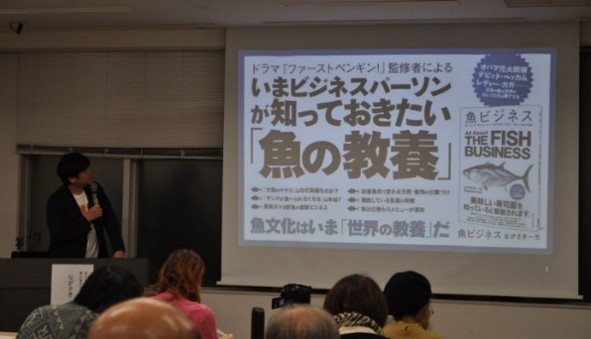
Recent publication: “Fish Business”
2. Japan, Tokyo, Minato Ward, and Fish
- Fish are an important source of protein for Japan
It is believed that people in Japan have been eating fish for over 7,000 years. Various fish bones have been excavated from Jomon period shell mounds and other sites. According to FAO (Food and Agriculture Organization of the United Nations) data, as of 2018, the annual per capita consumption of fish and shellfish in Japan was 45 kg, more than double the world average of 20.5 kg.
Fish have also been incorporated into other cultural aspects, such as dances and festivals in local areas.
- Trends differ by fish species. Looking at blue fish, horse mackerel is purchased more in western Japan (ranked 1st is Nagasaki City), while saury is purchased more in eastern Japan (ranked 1st is Sapporo City). The regions where fish are consumed the most vary depending on the species.
- Tokyo is the 5th largest prefecture in Japan in terms of expenditure on fish. Tokyo is also characterized by the fact that various seafood from all over Japan and the world gathers there. Toyosu handles as many as 500 items, making it the world’s largest fish market in terms of transaction value. In addition, Tokyo has a large production volume of many fish species in its fisheries, including Oshima Island, Tokyo Bay, and inland rivers.
- For tuna consumption, Shizuoka City ranks 1st (having Yaizu Port), and Kofu City ranks 2nd (although it has no coastline, there has been a long-standing route for transporting tuna from Shizuoka’s port).
- Trends differ by fish species. Looking at blue fish, horse mackerel is purchased more in western Japan (Nagasaki City is number one), while saury is purchased more in eastern Japan (Sapporo City is number one). The regions where fish are consumed most vary depending on the species.
- Tokyo is also characterized by the gathering of various seafood from all over Japan and the world. Toyosu handles 500 different items, making it the world’s largest fish market by transaction value. Furthermore, Tokyo has a large production volume of many fish species in its fishing industry, including Oshima Island, Tokyo Bay, and inland rivers.
- When serving sushi on a wooden platter to foreigners visiting Tokyo, they appreciate the amazing variety of fish from all over Japan that they can eat at once.
- Minato Ward has a long history with fish. During the Edo period, the coastline was a sandy beach called “Shibahama,” and the neighborhood towns were obligated to supply fish to Edo Castle, and thus supported Edo’s food culture.
- After the Great Kanto Earthquake, a temporary market was established in Shibaura, but it later moved to Tsukiji, and it can be said that one of the roots of the current Toyosu Market was in Minato Ward.
3. Changes in the types of fish delivered to our tables and their causes
- The types of fish being caught are changing.
Yellowtail are being caught in Hokkaido → Changes in ocean currents, perhaps the meandering of the Kuroshio Current has ended.
The Noto Peninsula earthquake has caused crustal movements in the ocean, leading to changes in fish species.
The Seto Inland Sea’s nutrient levels have decreased, making it difficult to catch sand eels and octopus → It was previously said that this was due to reduced nitrogen and phosphorus levels in water treatment plants. More recently, it has been discovered that for sand eels, the main reason is that global warming has reduced the amount of plankton they feed on, causing them to seek food even in the summer, leading to predation by natural enemies (such as Spanish mackerel).
The seawater temperature in Tokyo has risen by 3 degrees in winter and is not falling → Cutlassfish and black sea bream are being caught in abundance.
- Causes include changes in sea surface temperature and currents, ocean acidification (due to CO2), cyclical fluctuations, and crustal movements of the ocean. Human-induced impacts from changes in the coastal environment and fishing also play a role. Global warming is not the only cause.
<Recent News Topics>
- Tuna populations have increased, leading to abundant catches and making them more affordable than before. They are entering fixed nets even though they are not targeted in fishing grounds. However, if there are no catch quotas, they must be released despite the high probability of death, which is not entirely positive from a resource conservation perspective.
- The catch of Japanese flying squid (a cephalopod) has decreased to one-seventh of what it was 10 years ago. This year is a bountiful catch, but due to catch quotas, fishing was temporarily impossible, suggesting a review of resource management methods may be necessary. Incidentally, Japanese flying squid have a lifespan of one year and die after spawning.
- The possibility of including eels in the trade regulations under the Washington Convention was discussed at a conference but was rejected. Incidentally, eels are not commonly eaten in Europe or America.
4. <Changing Norms about Fish in the Future>
In the past, fish were bought at local fish shops. Currently, they are bought at supermarket fish counters.
- Supermarkets, which rely on mass distribution, demand large quantities of fish of the same specifications, but fishermen cannot standardize their catches, and they don’t know what they’ll get until the nets are pulled up. Fish that cannot be standardized are incompatible with modern distribution. Therefore, modern distribution requires freezing and aquaculture.
- Technological advancements include improvements in preservation and freezing technology, which allow for consistently delicious fish, but diminish the concept of enjoying seasonal fish. Advances in aquaculture technology allow for tailoring taste to market needs, but this may lead to a decline in flavor diversity. New production technologies, such as cell culture for fish meat production, enable more efficient production, but this raises concerns about a decline in the diversity of fish-eating culture.
- Changing common sense
When you think of yellowtail, you used to think of the Hokuriku region → Today, yellowtail is also found in Hokkaido. The “common sense” about fish from a while ago has changed.
4. <Changing Norms about Fish in the Future>
- In the past, fish were bought at local fish shops. Currently, they are bought at supermarket fish counters.
- Supermarkets, which rely on mass distribution, demand large quantities of fish of the same specifications, but fishermen cannot standardize their catches, and they don’t know what they’ll get until the nets are pulled up. Fish that cannot be standardized are incompatible with modern distribution. Therefore, modern distribution requires freezing and aquaculture.
- Technological advancements include improvements in preservation and freezing technology, which allow for consistently delicious fish, but diminish the concept of enjoying seasonal fish. Advances in aquaculture technology allow for tailoring taste to market needs, but this may lead to a decline in flavor diversity. New production technologies, such as cell culture for fish meat production, enable more efficient production, but this raises concerns about a decline in the diversity of fish-eating culture.
5. <How to keep eating delicious fish>
Eating a variety of fish helps to diversify resources.
Supporting the fish you want to eat will make sure you keep eating fish.
Instead of trying to learn everything yourself, befriending people who are knowledgeable about fish will help you update your information.
~ Let’s energize Japan with fish!
(Written by UMENE, and translated by MIYASHITA)